

Sweden is spending millions stripping devices from classrooms. They’ve got it wrong. And if we’re not careful, the UK will make the same mistake.
There are two completely separate conversations happening right now about children and technology, and people are treating them as one. Confusing them will damage the positive use of technology in education, and the longer we let the conflation go unchallenged, the harder it becomes to have either conversation properly.
The first conversation is that children have deeply unhealthy relationships with their devices. This is real, and it is serious. Ofcom’s 2024 data found that a quarter of 5 to 7-year-olds now own a smartphone. 40% of under-13s have a social media profile, despite every platform setting 13 as the minimum age. King’s College London found that nearly 25% of young people use their phones in ways consistent with behavioural addiction, and their 2024 follow-up studies linked problematic smartphone use directly to anxiety, depression and insomnia in UK teenagers. These are not fringe cases. This is a pattern shaped at home by years of unchecked access and platforms engineered to create dependency. It is overwhelmingly a home problem.
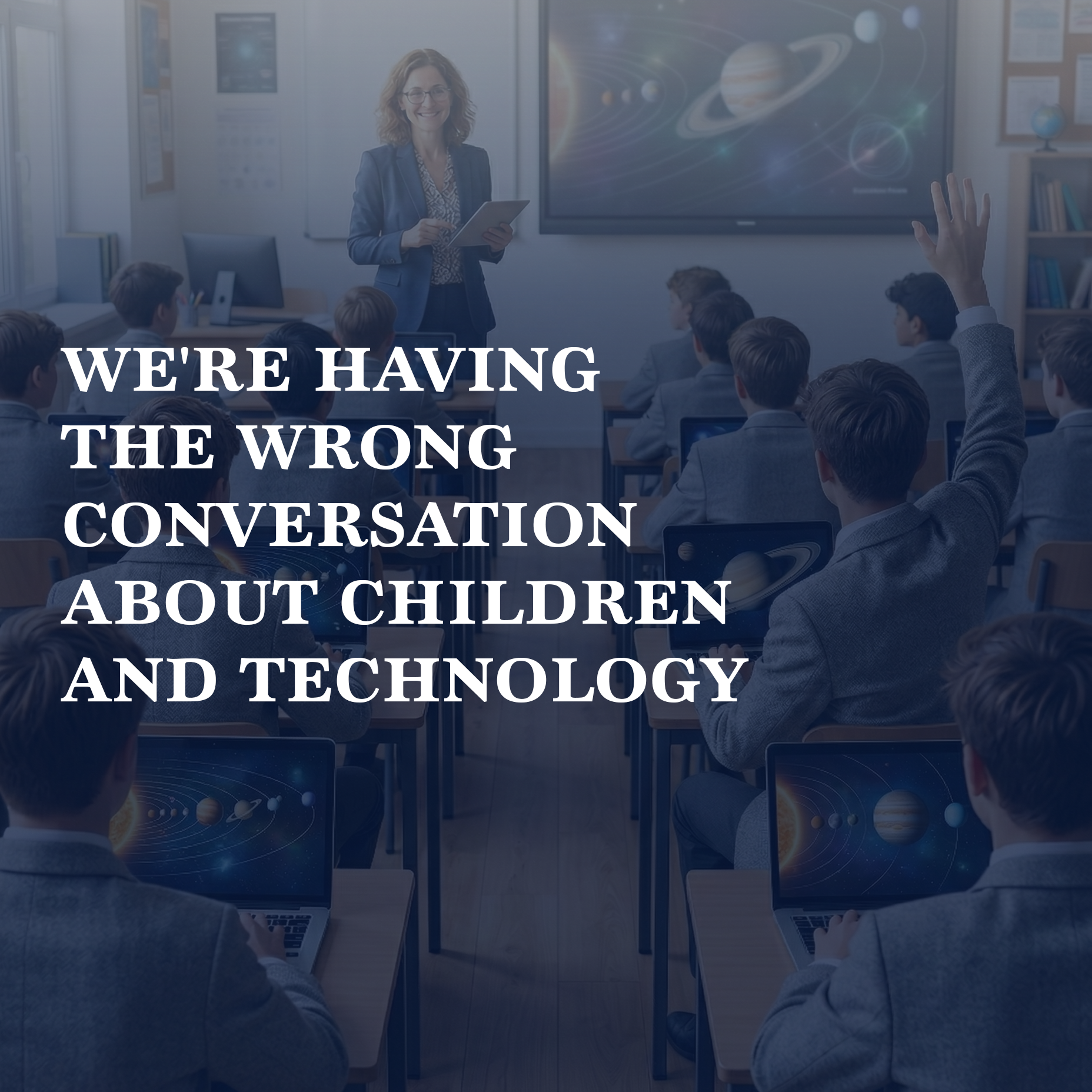
The second conversation is the idea that technology in education is itself the issue, that classrooms should be stripped of devices and replaced with textbooks. I watched a LinkedIn post celebrating Sweden’s decision to do exactly that gain serious traction recently, comments full of praise for their approach. It felt like a superficial way to grab attention rather than present a meaningful case, because the applause for that approach borrows its energy from the first problem while having almost nothing to do with it.
The evidence doesn’t support it either. The meta-analyses on screens in education consistently show small effects in both directions, highly dependent on how technology is used, the age group, and whether there is teacher mediation. Anyone claiming this is settled science in either direction is overstating the evidence. Sweden’s PISA decline is being attributed to screens in a way the data doesn’t cleanly support. The Swedish National Agency for Education (Skolverket) pointed to the pandemic as the primary driver, with Peter Fredriksson, their Director General, describing a clear “pandemic effect” driven by high absenteeism and distance learning. Demographic shifts and broader systemic issues also contributed. Blaming devices is politically convenient, and gets votes, but it is a simplification. A teacher choosing to use technology in a structured lesson looks nothing like a child scrolling TikTok unsupervised at midnight. Treating those as the same thing is lazy thinking, and it will do real damage to how schools are able to teach.
A teacher choosing to use technology in a structured lesson looks nothing like a child scrolling TikTok unsupervised at midnight.
Let me be clear about what I am arguing and what I am not. I want my teenager to have a phone before and after school. When they are travelling, they need to be contactable, and I need to know they are safe. But they do not need it during the school day. The practical challenge for schools is not whether to ban phones; it is how to manage the transition at the gate, and that is a solvable problem. I would go further: there is a strong and growing case for banning social media access for under-16s entirely, and the more I look at the data, the harder it becomes to argue against it. would go further: there is a growing case for banning social media for under-16s, and the data is hard to argue against. But there’s also a case for moderation over restrictions, making this argument far less black and white than the conversation would have us believe.
Perhaps it should be banned for some adults as well, but that is a conversation for another day.
I say this as a parent who doesn’t always get this right. My older teen has genuine, meaningful conversations with friends on Snapchat and I see no real harm in that. But I also watch the platform’s design take over: the compulsive checking, the panic when a streak is about to break. That streak is not a friendship; it is a retention mechanic borrowed from mobile gaming, designed to keep them opening the app whether they have something to say or not. That is happening in my home, not in a classroom, and no school policy will change it.
That streak is not a friendship; it is a retention mechanic borrowed from mobile gaming.
I’ve written before about how gaming and social platforms function as genuine social spaces for teenagers, and I stand by that. The issue isn’t the platform itself; it is the design choices that exploit the connection young people are there to find. The anxiety about a broken streak is not a social instinct; it is an engineered response, and the fact that it works so well on teenagers should concern us far more than whether a maths teacher is asking students to use laptops in a lesson.
Sweden is not leading the way. It is spending over €100 million on a politically convenient answer to a question it hasn’t properly asked.
The honest conversation is not about whether schools use technology responsibly. Most do. It is about whether parents do, and whether our habit of reaching for absolute positions on screens is letting the actual problem go unaddressed while punishing the institutions that were never the cause. Sweden is not leading the way. It is spending over €100 million on a politically convenient answer to a question it hasn’t properly asked. We should be learning from that mistake, not repeating it.