

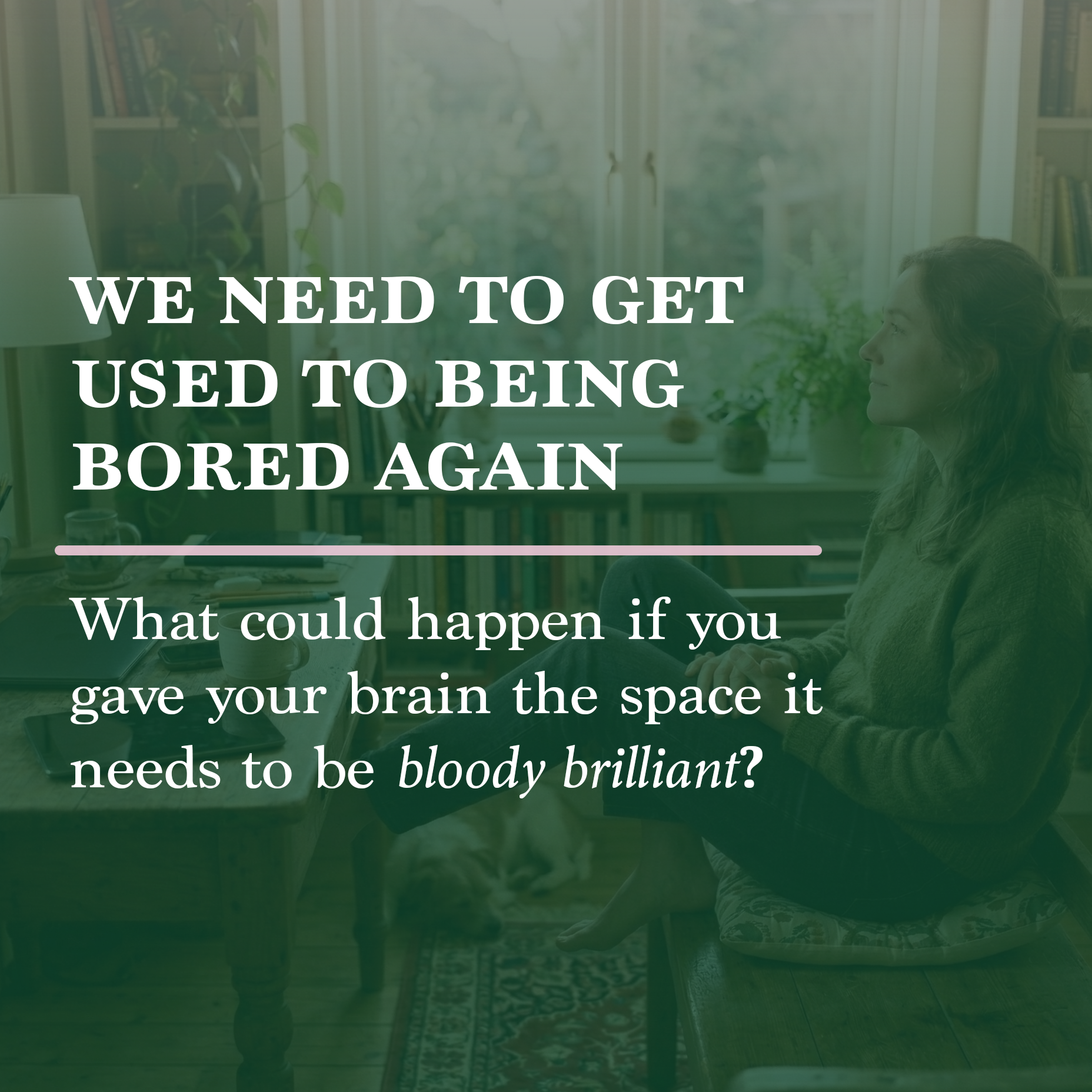
When do you have your best ideas, your most creative thoughts, or even your “eureka” moments?
Although there are always exceptions, I bet it’s not when you’re scrolling through a social feed. The hint’s in the name. You’re being fed. You’re the consumer, and the key is to keep you eating from the all-you-can-eat buffet.
If you’re anything like me, it’s when you’re staring into space, walking outside getting your heart pumping and filling your lungs with oxygen (the stuff your brain craves), on the treadmill, lost in a book, or lying in bed when your brain won’t switch off. Instead of letting it speak, we repress it with blue light and more scrolling. Which is mad when you think about it as a strategy for rest.
Your brain’s best work happens when you stop feeding it
There’s real science behind this. When your brain isn’t being bombarded with stimulation, it enters what neuroscientists call “default mode.” The default mode network (DMN) is a system of connected brain areas that becomes active when you’re not focused on what’s happening around you. It’s the state your brain shifts into during daydreaming, self-reflection, and the kind of free-flowing thinking that connects ideas you’d never consciously put together.
This isn’t idle time. It’s some of the most productive work your brain does.
Research has consistently shown that the DMN is directly involved in creative thinking. People who engage in frequent mind wandering tend to score higher on measures of creativity, because the DMN allows the brain to make connections between seemingly unrelated ideas. That’s the foundation of original thought.
A 2025 study published in Nature Communications Biology, the largest creativity neuroscience study to date with 2,433 participants across five countries, found that creativity can be reliably predicted by the number of dynamic switches between the default mode network and the brain’s executive control network. In plain terms: your brain’s ability to toggle between focused work and unfocused wandering is what produces creative thinking. Kill the wandering, and you damage the creativity.
Researchers now estimate we spend as much as 50 percent of our waking time in this default mode state. Or at least, we used to. The question is whether we’re still allowing it to happen, or whether we’ve filled every available moment with stimulation that stops it before it starts.
Everything started with a crazy idea
I spend my working life building technology that works for people. I’ve seen what happens when it’s done well: processes get simpler, decisions get sharper, communication gets clearer. The ability to simplify and improve process in the way AI is doing right now is extraordinary. I’m not anti-technology. That should be obvious from the work I do every day.
But that can’t be all the time.
Innovation comes from the human brain. Everything we see around us has been initiated by someone who had a crazy idea that might just work. And those ideas came from a mind that was given enough space to breathe, to think, to explore, to talk nonsense and refine it into something incredible.
When will you ever give yourself the time to be your bloody brilliant self?
If instead of taking the time to allow our minds to meander, removing the stimulation long enough to get into some deep thinking (the place where the unexpected starts to emerge and the unknown starts to float to the top), we default to picking up the phone and staring at a never-ending scroll of videos and everything else the algorithm throws at us to keep us engaged, then when will you ever give yourself the time to be your bloody brilliant self?
Our minds are designed to create. So it’s no surprise we feel frustrated if all we do is consume.
The people who built the trap don’t live in it
It should come as no surprise that the people behind the technology that’s trying to turn our brains off are some of the least likely to use the tech they made. Not because they’re massive hypocrites who hate the stuff they’re feeding you, but because they know when the tech is working for you and when it’s working to trap you. They know that to achieve the great things they plan, they need the technology to do it. They also need the space to think without it.
Think about all the ways technology has improved society for the better. Science, medicine, humanitarian work, education. This is what happens when we harness it and break it in for our own purposes. The antithesis of this is the disturbing stuff I discussed in my last post: young people left to their own devices (so to speak) without the adult in the room demonstrating what positive use looks like.
This isn’t about being a fun sponge
The problem is when it turns into mindless, infinite death scrolling to fill the void, to avoid the boredom that, if allowed to linger, could be transformative.
Technology can be fun too. Gaming isn’t going to make your teen socially inept. Often they’re being sociable with friends at the same time as playing. Watching interesting videos on YouTube won’t rot your brain, and engaging with friends and connections on social media isn’t in and of itself a problem. These can all be a positive in moderation and accompanied by some self discipline. The problem is when it turns into mindless, infinite death scrolling to fill the void, to avoid the boredom that, if allowed to linger, could be transformative.
But let’s be honest here, the fun that creates core memories is more likely found with the people around us than in a video of someone you’ve never met.
The blue light problem
Those nights when your brain won’t switch off and you reach for the phone to help you sleep deserve a specific mention, because the science here is particularly clear. Blue light from screens suppresses melatonin production, the hormone your body produces to help you fall asleep. So the thing you’re reaching for to quiet your racing mind is actively making it harder to sleep. Meanwhile, the racing mind you’re trying to silence might have been working on something worth hearing, if you’d given it a few more minutes of quiet instead of drowning it out with someone else’s content.
What I’d suggest we all do about it
We need to remind ourselves, and show our kids, that technology with a purpose is a strength, while also protecting the space where our brains can do their best work.
This doesn’t require a digital detox or a dramatic lifestyle overhaul. It starts with noticing the impulse. That moment when you’re waiting for a kettle, standing in a queue, sitting on a train, and your hand moves towards your pocket before you’ve even consciously decided to check anything. That’s the moment where the choice lives.
Manoush Zomorodi’s book Bored and Brilliant explores this relationship between boredom and original thinking in detail. She led over 20,000 people through an experiment to help them unplug from their devices and reclaim the mental space that constant connectivity was eroding. Her central argument is simple: when we resist the urge to fill every spare moment with digital distraction, we open up space for imagination and deeper thinking. She grounds it in the neuroscience and cognitive psychology of mind wandering, and the book is full of practical steps that are manageable rather than extreme. It’s worth a read if this resonates with you.
When was the last time you allowed yourself to be properly bored?
What might happen if you ignored the impulse to fill the silence and leaned into it instead? Next time the urge hits to pick up your phone, don’t. See what your brain does with the space.
You might surprise yourself.
This post follows on from my earlier blog about Sweden’s decision to strip technology from classrooms and the oversimplified narratives driving that conversation. The argument there was that the debate around children and technology is too often reduced to “tech good” or “tech bad” when the reality is far more complex. This post picks up where that one left off: if the answer isn’t to remove technology entirely, and it isn’t to let it run unchecked, then the real question is how we develop the judgement, in ourselves and in our kids, to know when it’s serving us and when it isn’t.